Research
Aural Diversity has generated a body of interdisciplinary research spanning music and sound studies, acoustics and engineering, hearing sciences, architecture, psychology, and cultural history. This page gathers principal scholarly outputs of the project and its collaborators, including peer-reviewed articles, conference proceedings, creative research, and related work that engages with aural diversity as a concept and research agenda.
Methodological Innovation
Aural Diversity has not only generated research outputs but has also developed new methodological approaches for investigating hearing difference. The project has foregrounded experts by experience as research collaborators rather than subjects, integrated artistic practice with scientific and clinical inquiry, and created structured dialogue between acoustics, hearing sciences, architecture, design, and the humanities.
Through workshop-based knowledge exchange, co-commissioned creative works, policy-facing technical reviews, and interdisciplinary publication, the network has advanced population-aware models of listening that move beyond normative “otologically normal” assumptions embedded in standards and assessment frameworks. These methodological contributions now inform ongoing research, policy engagement, and doctoral training initiatives.
Outputs
Book
Aural Diversity (Drever & Hugill eds., Routledge, 2022)
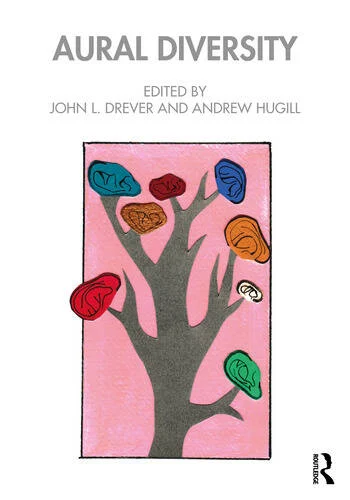
Aural Diversity addresses a fundamental methodological challenge in music and soundscape research by considering the nature of hearing as a spectrum of diverse experiences.
Bringing together contributors from the arts, humanities, and sciences, it challenges the idea of a normative listening experience and proposes new approaches to sonic arts, environments, design, and creative listening practice.
Full table of contents available on the publisher’s page.
Peer-Reviewed Articles
The concept of aural diversity has generated work across acoustics, sound studies, musicology, audiology, disability studies, and design research. The following publications include direct outputs of the AHRC network as well as independent research that explicitly engages the concept. Together, these publications indicate a gradual shift from normative auditory models towards more plural, population-aware frameworks within both arts and sciences.
This bibliography includes principal project outputs and a selection of peer-reviewed and scholarly publications that explicitly engage with aural diversity as a concept. It is indicative rather than exhaustive and will be updated as the field develops.
InterNoise 2022 Proceedings
A series of papers presented at InterNoise22 (Glasgow) engage with aural diversity themes across acoustics, soundscape, and hearing research.
- Davies, W. (2022). “Can acoustic design accommodate aural diversity?” INTER-NOISE and NOISE-CON Congress and Conference Proceedings 265 (2).
- Drever, John Levack, Marta Cobianchi, and Carmen Rosas-Pérez. (2022). “Auraltypical acoustics? A critical review of key standards and practices.” INTER-NOISE and NOISE-CON Congress and Conference Proceedings 265 (1).
- Hugill, Andrew. (2022). “Aural diversity: Noise control and a sustainable future.” INTER-NOISE and NOISE-CON Congress and Conference Proceedings 265 (6).
- Renel, William. (2022). “Non-normative sonic space: Exploring the divergent capacities of soundscape design in the built environment.” INTER-NOISE and NOISE-CON Congress and Conference Proceedings 265 (6).
- Rosas-Pérez, Carmen, and Laurent Galbrun. (2022). “Human diversity in acoustics: Towards a more inclusive sound environment.” INTER-NOISE and NOISE-CON Congress and Conference Proceedings 265 (1).
Acoustic Standards and Population Variance
A Defra-commissioned technical review examined the representativeness of the A-weighting curve in environmental noise assessment and explored how acoustic standards might better reflect auditory diversity across the population.
- A-Weighting for All? Acoustic Assessment for an Aurally Diverse Population (Technical review, University of Salford)
The work analyses assumptions embedded in existing noise metrics and considers methodological approaches for incorporating variance in auditory perception into acoustic assessment frameworks.
Recent Journal Articles
- Aabo, Marie Gorm. (2026). “Tinnitus attuning: An ethnographic exploration of aural diversity and how we hear together as sonic citizens.” Seismograf/DMT. (forthcoming)
- Chatburn, Katie, Kirsten van den Bosch, and Arezoo Talebzadeh. (2026). “A critical perspective on inclusion and diversity in soundscape studies.” JASA Express Letters 6: 037201.
- Greenland, E., et al. (2026). “Universal acoustic design for schools: An evidence-based approach.” Applied Acoustics 242: 110596.
- Rosas-Pérez, Carmen, Laurent Galbrun, Sarah R. Payne, Andrew Dickson, and Michael E. Stewart. (2025). “More than noise: Lived experiences of autistic people in real-life acoustic environments.” Applied Acoustics 233: 110581.
- Rosas-Pérez, Carmen, and Laurent Galbrun. (2025). “Diversity in sound perception in survey to noise sensitive people and relevance for experimental and field studies.” Proceedings of Forum Acusticum 2025.
Additional Research Engaging Aural Diversity
Sonic Arts and Music Studies
- Cook, Christopher. (2021). “Trevurr: A dialogic composition on dementia, auraldiversity and companion listening.” Organised Sound 26 (3): 334–343. https://doi.org/10.1017/S1355771821000206
- Drever, John Levack. (2019). “Primacy of the ear—but whose ear? The case for auraldiversity in sonic arts practice and discourse.” Organised Sound 24 (1): 85–95.
- Drever, John Levack. (2021). “Sound art: Hearing in particular.” In The Oxford Handbook of Sound Art, edited by J. Carlyle and G. Lane, 555–572. Oxford: Oxford University Press. https://doi.org/10.1093/oxfordhb/9780190274054.013.38
- Abbott, Emily H. R., Ailsa Critten, and Elizabeth H. MacGregor. (2024). “Relaxed performances: Supporting aural diversity and neurodiversity among classical concert audiences.” Sound Studies 10 (1): 1–18.
Acoustics, Soundscape, and Built Environment
- Renel, William. (2018). “‘Auraldiversity’: Defining a hearing-centred perspective to socially equitable design of the built environment.” Built Environment 44 (1): 36–51.
- Cobianchi, M. (2025). “Aural diversity in soundscape assessment: The challenge of inclusivity in planning.” Proceedings of Forum Acusticum 2025.
- Rosas-Pérez, Carmen, Laurent Galbrun, Michael E. Stewart, and Sarah R. Payne. (2023). “How can anyone learn or teach? Experiences of autistic people with sound in schools and universities.” Proceedings of Meetings on Acoustics 51 (1): 015001.
- Wu, Y., et al. (2022). “Sound perception of blind older adults in nursing homes.” Buildings 12 (11): 1838.
- Aletta, Francesco, and Simone Torresin. (2022). “The sounds around us in cities and buildings.” Frontiers for Young Minds 10: 910059.
Hearing, Health, and Listening Studies
- Thompson, Marie. (2024). “Mapping tinnitus.” The Senses and Society 19 (1): 78–94.
- Drever, John Levack, and Vinita Bharat. (2023). “Auraldiversity: Do you hear differently?” Frontiers for Young Minds 11: 979480.
- Jørgensen, E., et al. (2023). “Auditory environment diversity quantified using entropy from real-world hearing aid data.” Frontiers in Digital Health 5: 1179160.
- D’Arcy, J. (2022). “Do you hear what I hear? Creative approaches to sharing and simulating diverse hearing.” Creative/interactive research project.
Research Directions
Current work engaging aural diversity is increasingly oriented towards acoustic standards, soundscape assessment, inclusive design, tinnitus studies, autistic listening, and artistic research. Together these developments suggest a growing shift away from normative auditory models towards more plural and population-aware understandings of hearing.
Creative & Artistic Research
- Simon Allen (2019). Map Fragments. Composition for signed text and mixed ensemble. Commissioned for Aural Diversity Concert 1 (Arts Council England; GNResound Ltd). Documentation.
- Simon Allen (2019). Aerosol. Composition for prepared tuning forks and instruments. Commissioned for Aural Diversity Concert 2 (Arts Council England; Arts and Humanities Research Council). Documentation.
- Nina Danon, Francesco Cassino, Lily Hope (2021). Volcano. Fixed media electroacoustic composition. Commissioned for Aural Diversity Network Workshop 5 (Arts Council England; Arts and Humanities Research Council). Documentation.
- John Levack Drever (2019). Sanitary Tones: ayre #3. Composition for live and pre-recorded vocal sounds. Commissioned for Aural Diversity Concert 1 (Arts Council England; GNResound Ltd). Documentation.
- Rosa Francesca (2019/2023). Improvisa Live. Composition for solo clarinet and EEG device. Performed at Aural Diversity Network Workshop 5. Documentation.
- Ed Garland, Josephine Dickinson, Jay Afrisando (2023). your awe or oar or ore or audio or order? Video installation. Commissioned for Aural Diversity Network Workshop 5 (Arts Council England; Arts and Humanities Research Council). Documentation.
- Hugh Huddy (2023). Seafield. Sound installation. Commissioned for Aural Diversity Network Workshop 5 (Arts Council England; Arts and Humanities Research Council). Documentation.
- Andrew Hugill (2022). Digital Syzygies. Compositions for EEG devices and digital sounds. Commissioned by the Digital Score project with funds from the European Research Council. Documentation.
- Andrew Hugill (2019). Thirty Minutes for Diplacusis Piano. Commissioned for Aural Diversity Network Workshop 5 (Arts Council England; Arts and Humanities Research Council). Documentation.
- Andrew Hugill (2019). Kelston Birdsong. Composition for birdsong and ensemble. Commissioned for Aural Diversity Concert 1 (Arts Council England; GNResound Ltd). Documentation.
- Andrew Hugill (2022). Spectrum Sounds. Seven pieces for solo instruments and digital sound. Commissioned by The Space and all four Arts Councils of the UK. Documentation.
- Ricardo Huisman (2023). The Bone Conductor. Interactive installation piece. Performed at Aural Diversity Network Workshop 5. Documentation.
- Russ Palmer & Stina Ojala (2023). Feeling and interacting with musical instruments. Workshop and performance at Aural Diversity Network Workshop 5. Documentation.
- Amit Dinesh Patel / Simon Atkinson (2023). Undertone. Installation for vibrating floor. Commissioned for Aural Diversity Network Workshop 5 (Arts Council England; Arts and Humanities Research Council). Documentation.
- Will Renel (2023). Should We Listen to the Man on the Clapham Omnibus? Video installation. Commissioned for Aural Diversity Network Workshop 5 (Arts Council England; Arts and Humanities Research Council). Documentation.
- Matthew Spring (2019). Meditations on Hildegard. Composition for bells and hurdy-gurdy. Commissioned for Aural Diversity Concert 1 (Arts Council England; GNResound Ltd). Documentation.
- Sam Sturtivant (2019). Sensonic. Installation for vibrating floors. Commissioned for Aural Diversity Concert 1 (Arts Council England; GNResound Ltd). Documentation.
- Anya Ustaszewski (2019). Arbometallugism. Fixed media composition for ‘found’/everyday objects. Commissioned for Aural Diversity Concert 1 (Arts Council England; GNResound Ltd). Documentation.
- Anya Ustaszewski (2019). Vox Random. Fixed media composition for voice/speech sounds over a pre-recorded track. Commissioned for Aural Diversity Concert 1 (Arts Council England; GNResound Ltd). Documentation.